Showing posts with label GST. Show all posts

Tuesday, 21 July 2020

Top 50 Popular FREE Online Certification Courses

Hello Friends, My New EBook on "TOP 50 POPULAR FREE ONLINE CERTIFICATES"

Please READ all the Details.

Summary of the Blog :
Description of EBook
Why You Should Purchase This EBook? 
Steps for Purchase EBook


Description of EBook

Link for Purchase EBook :
☟ 

▪️ This e-book contains links of Top 50 Certificates which are Recognized by well-known institutes and companies.

▪️ In this e-book, Certification Courses links are based on many categories like Finance, Economics, Marketing, Stock Market, Accounting, Taxation, Corporate, Management, Personal Development and many more.

▪️ We have done hard work to find free and best certification course information for students for any field's students. We have collected all information and created e-book so anyone can find useful for nominal charge.

▪️ We are sure these certificates will be helpful for learning and a better Resume or CV. After purchase you can contact us if you stuck anywhere during Certificates like Registration Process.

Why You Should Purchase This EBook ?

1. In this Ebook, All Certification Courses Provided by Recognized Institute, Company, Firms etc.

2. In this Ebook, You can Enhance your Knowledge in effective Manner.  

3. In this Ebook, All this Certification Courses can Better Impact on your Resume or CV.

4. In this EBook, You can build your Impression very effectively in comparison to others because you are doing this courses.

5. In this Ebook, You can Learn Many New things on Finance, Economics, Marketing, Stock Market, Accounting, Taxation, Corporate, Management, Personal Development and many more.

6. In this EBook, Any Field's of Students or any Professional can do this Certification Courses. 

7. In this EBook, There is not any Eligibility Criteria required. Anyone can do this Certification Courses. You can do this Courses anywhere.

8. In this EBook, All Certification Courses are Related to many categories like Finance, Economics, Marketing, Stock Market, Accounting, Taxation, Corporate, Management, Personal Development and many more.

Steps for Purchase EBook:

1. Click on below Link 

2. Click  on "BUY NOW" 

3. Click on "CONTINUE"
4. Fill All the Details as Mention. Then, Click on "CONTINUE"
5. Enter Coupon Code HITESHLUHAR for Discount
6. Click on "MAKE PAYMENT"
7. Select Any Payment Mode


Follow me for More Updates :

FB Page : http://bit.ly/2KBezYz
YouTube: https://bit.ly/2WwqOvXL

LinkedIn : https://bit.ly/3fPeFK2


Thanks for reading friends, I hope you will definitely Purchase this EBook.

If you have any queries, suggestions, and please comment below the blog.

You can follow me on the right side subscribe to me button by just entering your email id. 

Please LIKE my Facebook Page Easy Taxation by Hitesh Luhar

Take care and stay safe.😊😊


Saturday, 2 May 2020

Coronavirus (COVID-19): Key Announcements on Income Tax, GST, Finance and others

Coronavirus (COVID-19): Important Key Announcements on Income Tax, GST, Finance and others

Hello friends, Today I’m going to explain a topic "Coronavirus (COVID-19): Key Announcements on Income Tax, GST, Finance, and others"

You can read my previous blogs "GST in India- An Introduction" & "GST Framework In India"

The Union Finance Minister Smt Nirmala Sitharaman made a number of announcements on 24th March 2020 via video conferencing related to statutory and regulatory compliance matters and some reliefs for businesses to cope up with the difficult times of COVID-19.

Below is the summary of the Blog:

Summary
  • Income Tax
  • Goods & Services Tax (GST)
  • Customs
  • Financial Services
  • Corporate Sector OR Ministry of Corporate Affairs (MCA)
  • Insolvency and Bankruptcy Code (IBC)
  • Fisheries 
Income Tax

The last date for
  • Belated/Revised filing of ITRs for the FY 18-19 
  • Permanent Account Number (PAN) and Aadhar linking 
  • Vivad se Vishwas” scheme no additional 10% payment
Extended from
31st March 2020 to 30th June 2020

Issue of notice, intimation, notification, approval order, sanction order, filing of an appeal, furnishing of return, statements, applications, reports, any other documents and time limit for completion of proceedings by the authority and any compliance by the taxpayer including investment in saving instruments or investments for rollover benefit of capital gains under Income Tax Act, Wealth Tax Act, Prohibition of Benami Property Transaction Act, Black Money Act, Securities Transaction Tax (STT) law, Commodities Transaction Tax (CTT) Law, Equalization Levy law, Vivad Se Vishwas law where the time limit is expiring between March 20,2020 to June 29,2020 shall be
Extended to 30th June 2020 

Interest at a reduced rate of 9% p.a. shall be charged alternately of 12% or 18% p.a. towards the delayed payment/deposit of the following income tax levies, made between March 20,2020 and June 30,2020.

Note that there is no extension in the deadlines.
Goods & Services Tax (GST)

The last date for the
  • GST Returns for March, April & June 2020 on a staggered basis 
  • Opt for composition scheme 
  • Sabka Vishwas scheme from 31st March 2020 with no Interest charges
  • Issuance of notice, intimation, notification, approval order, sanction order, filing of an appeal, furnishing of return, statements, applications, reports, any other records where the time limit expires between March 20,2020 and  June 20,2020
  • Penalty fall to 5% interest on late filing of GST returns beyond 15 days for firms having turnover up to Rs. 5 crore
Extended to 30th June 2020 

Customs 

The taxpayers and/or the tax authorities have got an extensive time limit of up to June 30,2020 where the time limit for the following compliance matter lapses between March 20,2020 and June 29,2020:
  • Issue of notice, notification, approval order, sanction order, Filing of an appeal, furnishing of applications, reports, or any other documents.
  • Customs clearance will operate 24*7 to help Exporters and Importers up to  June 30,2020.
Financial Services 
  • You can now withdraw money from any Bank ATM without charges for 3 months.
  • Minimum balance charges waived off for bank accounts.
  • There shall not be any minimum balance requirement fees (in Bank accounts). 
  • In the case of Digital Trade transactions, Bank charges are being reduced.
Corporate Sector
  • The requirement of holding board meetings has been relaxed for 60 days for two quarters. 
  • Newly incorporated companies will be given an additional 6 months for declaration of commencement of business. 
  • For 2019-20, if independent directors have not been able to hold a single meeting, it will not be seen as a violation.
  • Applicability to Create Deposit Reserve of 20% of deposits by April can now be complied with by 30 June 2020.
  • Requirements of Auditor's Report order 2020 which was assumed to come into force for Financial Year 2020 will be effective from Financial Year 2021.
Insolvency and Bankruptcy Code (IBC)

Insolvency is a financial position of being – one that is reached when you are unable to pay off your debts or obligations on time.
Bankruptcy is a lawful process that serves the purpose of resolving the issue of insolvency.
  • Finance Minister Nirmala Sitharaman's government's move to consider raising the threshold limit to file any action under IBC from Rs. 1 lakh to Rs. 1 crore has come as a huge relief booster shot for SMEs (Small and Medium Enterprises), SSMEs (Sustainable Small and Medium Enterprises) and small businesses.
  • Insolvency and Bankruptcy Code (IBC) Section 7 (Initiation of corporate insolvency resolution process by the financial creditor), Section 9 (Application for initiation of corporate insolvency resolution process by the operational creditor), Section 10 (Initiation of corporate insolvency resolution process by corporate applicant) may be considered for 6 months if Economic scenario becomes worse. This will prevent companies from being forced into Insolvency and Bankruptcy Code (IBC) for default if the scenario worsens.
Fisheries
  • All the Sanitary Imports Permits (SIP) for the import of SPF Shrimp Broodstock and other Agriculture inputs which expires between 1st April 2020 and 15th April 2020 has been extended by 3 months
  • Delay in arrival of import consignments by up to 1 month will not be considered as ‘delayed receipts’. 
  • The time limit for the verification of documents and grant of NOC for quarantine has been relaxed from 7 days to 3 days.
Thanks for reading friends, I will bring more such interesting topics related to taxation. 

If you have any queries, suggestions, and please comment below the blog.

You can follow me on the right side subscribe to me button by just entering your email id. 

Please LIKE my Facebook Page Easy Taxation by Hitesh Luhar

Take care and stay home.😊😊

Saturday, 25 April 2020

GST Framework In India

Hello friends, Today I’m going to explain a topic "GST Framework In India"


1. DUAL GST


The Dual GST (Goods and Services Tax), was launched in India to clarify the entire GST process system. GST was launched so that the whole taxation system would become less complicated therefore delivering the economy rise. The Dual GST system was introduced so that the whole process could become less complicated. This also helped in obtaining the quote ‘One Nation One Tax’ true. So let us understand Dual GST.

Dual GST is a type of GST in which both SGs and CGs will levy GST individually, rather than center alone levying taxes and sharing their revenues with the states. They will have various rates and possibly different commodities and services in which they are levied.


Diagram:

The Components of Dual GST are:

1.CGST (Central GST)
2.SGST (State GST)
3.UTGST (Union Territory GST)
4.IGST (Integrated GST)

2. CGST/SGST/UTGST/IGST

CGST
Central Goods and Services Tax or CGST is the indirect tax levied by the Central Government (CG). It is levied on the transaction of goods and services which are initiated within the state i.e. intrastate. 

SGST
State Goods and Services Tax or SGST represents the tax imposed by the State Government(SG). SGST is levied on the transaction of intra-state sales of goods and services, i.e. sales made within a state.

UTGST
UTGST is exactly the way linked to SGST. The only variance is that the tax revenue goes to the treasury for the particular direction of union territory where the goods or services have certainly been used. There is a key differentiation between union territory and states. The Union Territory immediately comes under the direction of the Central Government and does not have its own elected legislature as in the case of States.

IGST
IGST is levied on all inter-state supply of goods and services by the Central Government. CGST, SGST & UTGST which are levied upon the supply of goods or services within a state.

IGST has given a uniformity to taxation on the supply of goods and services made outside the state. These practices both at a supply made outside the state and those made outside the country.

3. LEGISLATIVE FRAMEWORK

There is single legislation – GGST Act, 2017 for levy GST similarly,
  • Union Territories without Legislatures:
  • Andaman and Nicobar Islands
  • Chandigarh
  • Daman and Diu
  • Dadra and Nagar Haveli
  • Lakshadweep
  • Ladakh
  • Jammu & Kashmir
Union Territories with their own legislatures:
  • Ponducherry
  • Delhi
There are 35 GST Act in India:


4. CLASSIFICATION OF GOODS & SERVICES

Harmonised System of Nomenclature (HSN) is used for classification of Goods:
HSN codes to be declared:


- In the case of Imports/Exports, the HSN code of 8 digits shall be compulsory.


Definition HSN Code?

HSN code stands for “Harmonized System of Nomenclature”. This system has been entered for the methodical classification of goods all over the world. HSN code is a 6-digit uniform code that classifies 5000+ products and is accepted globally. It was developed by the World Customs Organization (WCO) and it came into force from 1988.

Work of HSN code?

It has about 5,000 product groups, each named by a six-digit code, designed in a legal and logical arrangement. It is recommended by well-defined rules to perform consistent classification.

Importance of HSN? 

The main objective of HSN is to categorize goods from all over the World in a precise and relevant way. This draws in an identical classification of goods and facilitates worldwide commerce.


HSN Worldwide
The HSN scheme is accepted by more than 200 countries and economies for purposes such as:
  • Uniform classification
  • Base for their Customs tariffs
  • Collection of international trade statistics
Over 98% of the commodities in worldwide trade is analyzed in phases of the HSN.


HSN number for each product is affirmed by most of the countries. The HSN number remains the same for almost all goods. Though, HSN number used in some of the countries varies little, based upon the kind of goods listed.

HSN in India


India is a member of the World Customs Organization (WCO) since 1971. It was basically using 6-digit HSN codes to analyze commodities for Customs and Central Excise. Succeeding Customs and Central Excise added two more digits to make the codes more accurate, appearing in an 8 digit analysis.

HSN importance under GST?


The purpose of HSN codes is to make GST precise and globally accepted.


HSN codes will remove the need to upload a detailed interpretation of the goods. This will save time and make filing easier since GST returns are automatic.
A dealer or a service provider must provide an HSN/SAC wise report of sales in his GSTR-1 if his turnover falls in the above slabs.

HSN - wise summary of outward supplies

Sections
HSN Code List for
Section 1
Live Animals, Animal Products
Section 2
Vegetable Products
Section 3
Animal or Vegetable Fats and Oils and their cleavage stocks, made nutritious fats, Animal or Vegetable waxes
Section 4
Prepared Foodstuffs, Alcohols, Spirits and Vinegar, Tobacco and Manufactured Tobacco Substitutes
Section 5
Mineral Products
Section 6
Product of the chemicals or allied Industries
Section 7
Plastics and articles thereof, Rubber and articles thereof
Section 8
Raw hides, skins, Leather, Furskins and pieces thereof, saddlery, harness, travel goods, handbags, associated containers, articles of animal gut (other than silkworm gut)
Section 9
Wood, articles of wood, Wood charcoal, Cork, articles of cork, Manufacturers of straw, Esparto or other Plaiting Materials, Basketwork, and Wickerwork
Section 10
Pulp of wood or another Fibrous Cellulosic Material, Improved (Waste and scrap) paper or paperboard and articles
Section 11
Textile and textile articles
Section 12
Footwear, Headgear, Umbrellas, Sun Umbrellas, Walking-sticks, seat-sticks, whips, riding-crops, and parts thereof, Prepared feathers and articles formed therewith, Artificial flowers, Articles of human hair
Section 13
Pieces of stone, plaster, cement, asbestos, mica, or related materials, ceramic products, glass and glassware
Section 14
Cultivated pearls, valuable or semi-valuable stones, valuable metals, Metal clad with valuable metal, and pieces thereof, Imitation Jewellery, Coins
Section 15
Base Metals and Articles of Base Metal
Section 16
Machinery and mechanical devices, electrical devices, parts thereof, sound recorders and reproducers, television picture and such recorders and reproducers, and Components and Accessories of such article
Section 17
Vehicles, Aircraft, Vessels and Associated Transport Equipment
Section 18
Optical, Photographic, Cinematographic, measuring, checking, precision, medical or surgical devices and equipment, clocks, musical devices, and accessories thereof
Section 19
Arms and ammunition, parts and accessories thereof
Section 20
Miscellaneous Manufactured Articles
Section 21
Works of art, Collectors' Pieces, and antiques

Services Accounting Code (SAC) is used for classification of Services:
- 8 digit code of which first 2 digits is zero
Definition of SAC?


Service Accounting Code is related to the International HSN codes selected by other countries across the world. Similarly in GST the applicability of Service Accounting Codes has been determined for distinguishing the applicability of the individual tax rates to the services.
Importance of SAC?
SAC is the nomenclature adopted by the Goods and Services Tax Council for identifying services delivered under GST. These codes have been issued by the Central Board of Excise and Customs (CBEC) for the Identical classification of all the services as each service has been named a distinct SAC.

Work of SAC?

SAC Code is a labeling system for services formed by the Service Tax Department of India. Using GST SAC code, the GST rates for services are set in five slabs namely 0%, 5%, 12%, 18%, and 28%.


Thanks for reading friends, I will bring more such interesting topics related to taxation. 


If you have any queries, suggestions, and please comment below the blog.


You can follow me on the right side subscribe to me button by just entering your email id. 


Take care and stay home.😊😊

Monday, 20 April 2020

GST in India - An Introduction


Hello friends, Today I’m going to explain a topic “GST in India - An Introduction”.
Below is the summary of the blog.


Summary of the Blog:

  • The Genesis of GST in India 
  • Concept of GST
  • Need for GST in India 
  • Framework for GST as introduced in India 
  • Benefits of GST 
  • Constitutional Provisions


 The Genesis of GST in India 


Concept of GST
  • VALUE ADDED TAX: GST is a value-added tax levied on the manufacture, sale, and consumption of goods and services. 
  • CONTINUOUS and COMPREHENSIVE CHAIN OF TAX CREDITS: GST allows a complete and comprehensive continuous chain of tax credits from the producer’s point or service provider’s point up to the retailer level or consumer’s level through taxing only the value-added at an individual stage of the supply chain
  • BURDEN BORNE BY FINAL CONSUMER: Only the final consumer bears the GST charged by the last supplier in the supply chain, with set-off benefits at all the previous stages.
  • NO CASCADING OF TAXES: GST does not differentiate between goods and services and thus, the two are taxed at a single rate.


Need for GST in India 

The Amalgamation of different Central and State taxes into a single tax would assist
  • Mitigate the double taxation,
  • Cascading,
  • The multiplicity of taxes,
  • Classification issues,
  • The taxable event, and etc.
  • Leading to a common national market.
  • Value Added Tax(VAT) standards and regulations change from state to state.

Framework for GST as introduced in India 
  1. Dual GST
  2. CGST/SGST/UTGST/IGST
  3. Legislative Framework
  4. Classification of Goods & Services
  5. Composition scheme
  6. Registration
  7. Exemptions
  8. Seamless flow of credit
  9. GST common portal
  10. GSPs (GST Suvidha Providers) /ASPs (Application Service Providers)
  11. Compensation cess
  12. GST - A tax on goods & services

 Benefits of GST 
  • Removal of a group of indirect taxes such as CST(Central Sales Tax), VAT(Value Added Tax), Service tax, CAD(Current Account Deficit, SAD(Special Additional Duty), and Excise.
  • Less tax agreement and a simplified tax policy related to the current tax formation.
  • Removal of cascading effect of taxes i.e. removes tax on tax.
  • Reduction of manufacturing costs due to the lower burden of taxes on the manufacturing sector. Therefore the prices of buyer goods will be expected to come down.
  • Lower the burden on the common man i.e. public will have to discard less money to purchase the same products so were expensive earlier.

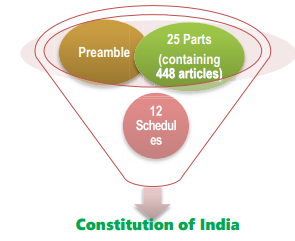
Constitutional Provisions


GST in India - Constitutional Provisions - easytaxationbyhitesh.blogspot.com


Thanks for reading friends, I will bring more such interesting topics related to taxation.

If you have any queries, suggestions, and please comment below the blog.

You can follow me on the right side subscribe to me button by just entering your email id. 


Take care and stay home.😊😊

Top 50 Popular FREE Online Certification Courses

Hello Friends, My New EBook on "TOP 50 POPULAR FREE ONLINE CERTIFICATES" Please READ all the Details. Summary of the Blog : ➤ Des...